Health & Fitness
Lessons From A Happy Childhood
Growing up in a special needs family means learning different lessons than growing up in a "typical" family. Not harder lessons, necessarily. But good ones.
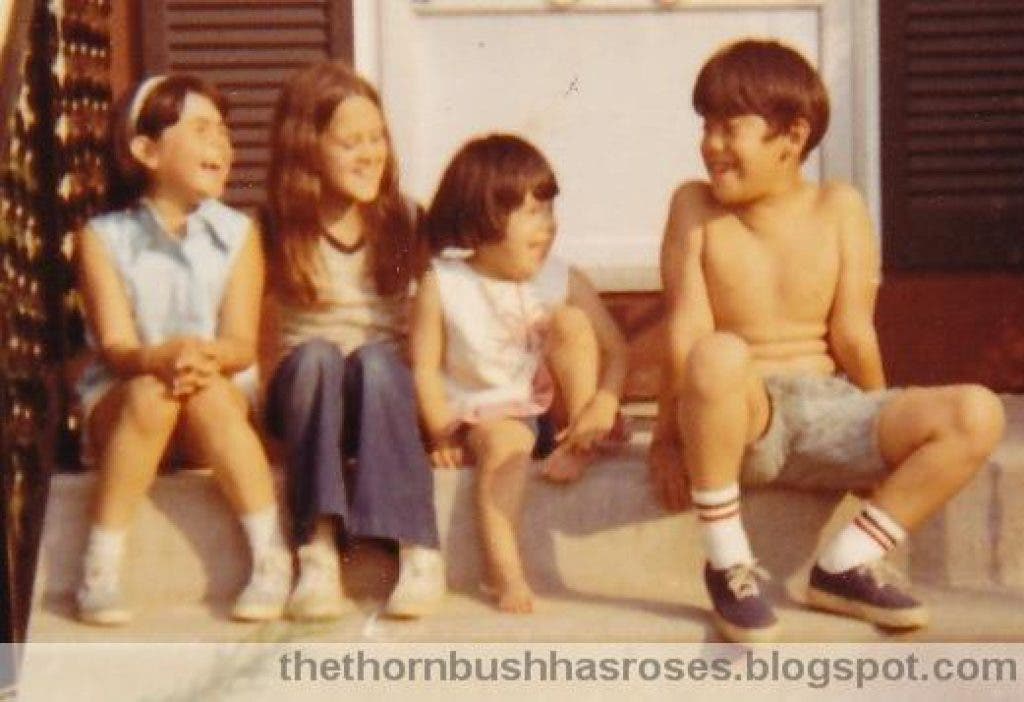
When the doctor at Yale looked over our decades-old photographs last year, searching for clues to the mystery of my siblings’ disabilities, he smiled. “A happy childhood,” he said.
And it was true. In an era when babies like Bobby and Jeannette were routinely institutionalized, my family was rare. My parents chose to keep my siblings at home. “Think of your other child,” the doctors appealed to them, trying to change their minds. “Think of what it will do to her, growing up with such a burden.”
Find out what's happening in Stonington-Mysticwith free, real-time updates from Patch.
Times have changed. Society has come to recognize that there are myriad ways in which even the most severely disabled enrich the lives of those around them—and that they have the right to grow up in loving homes rather than institutions. It is hard to believe that only a few decades ago this was not the case.
As the sister of two disabled siblings, my life was different in significant ways from the lives of people who grew up with "typically developing" sibs. I didn’t think it was different when I was a kid, of course—it was the only life I knew. But I realize now that my life lessons were different from those of my peers.
Find out what's happening in Stonington-Mysticwith free, real-time updates from Patch.
I’m not saying the lessons were harder. Difficult lessons are a part of everyone’s lives, and they arrive unannounced for folks from “typical” families as easily as for those who live with disability, personally or within their family. Life is always ready to throw any of us a curveball, to teach us something we hadn’t known before.
No, I don’t think the things I learned were harder than other people’s life lessons. But what I learned was different. Different in a way that others in special needs families may find familiar.
First off, I learned to celebrate small things. Like the time my sister learned how to pull a button through a buttonhole, or put a spoonful of sugar (or two, or three, or seventeen. . . oops!) in her tea. Or when my brother learned to dial the telephone to call his cousin, John—and not an angry stranger who thought he was being “pranked”!
I learned that humor can mark the difference between a disaster and an adventure.
I learned that milestones are milestones, no matter the timing. My siblings cheered me on when I learned to ride my bike without training wheels. I think I was seven. I cheered on my sister when she began walking at the age of five. I applauded my brother when he tied his shoes at age ten.
I learned to listen with my heart, and not my ears. My sister rarely said “I love you,” but her eyes and her smile said it for her. Even my brother, when he was older and unable, at times, to emerge from a world blossoming in his mind—when the voices of his schizophrenia became too compelling to escape—even then, Bobby would place his hand on my arm, and I knew he was glad to be with me. I learned that there was more than one way to say, “I love you.”
I learned how to worry—was the food cut too big? Was the ground too uneven? Would one of them choke or fall? I learned to be responsible for others.
I learned that I was lucky. I had two strong legs, and a mind that allowed me to reason and grow. I had my independence.
I learned that I was valuable. Not because of my accomplishments, but because I was me: Frances, sister of Bobby and Jeannette, making my way in the world the same way they did in their lives. One moment at a time. The way we all must do.
When we were little, the doctors beseeched my parents to put my siblings in an institution. Seaside Regional Center was practically in our back yard—why not be thankful it was there and utilize it? But my parents refused, because they understood what so many know now. That it’s not disability that shapes a home. It’s love.
“Think of your other child,” the doctors had said. “Think of what it will do to her, growing up with such a burden.”
My parents were among the ground breakers of the era, paving the way for families to keep their disabled children at home, declaring through their actions that there is a world of difference between facing a challenge and bearing a burden. But that’s not the reason they chose to disregard the doctors or to flaunt the conventional wisdom.
My parents were thinking of me. They were thinking of Bobby, and of Jeannette. They made a decision based on love. And for that, I will be eternally grateful.